The Types of Dice
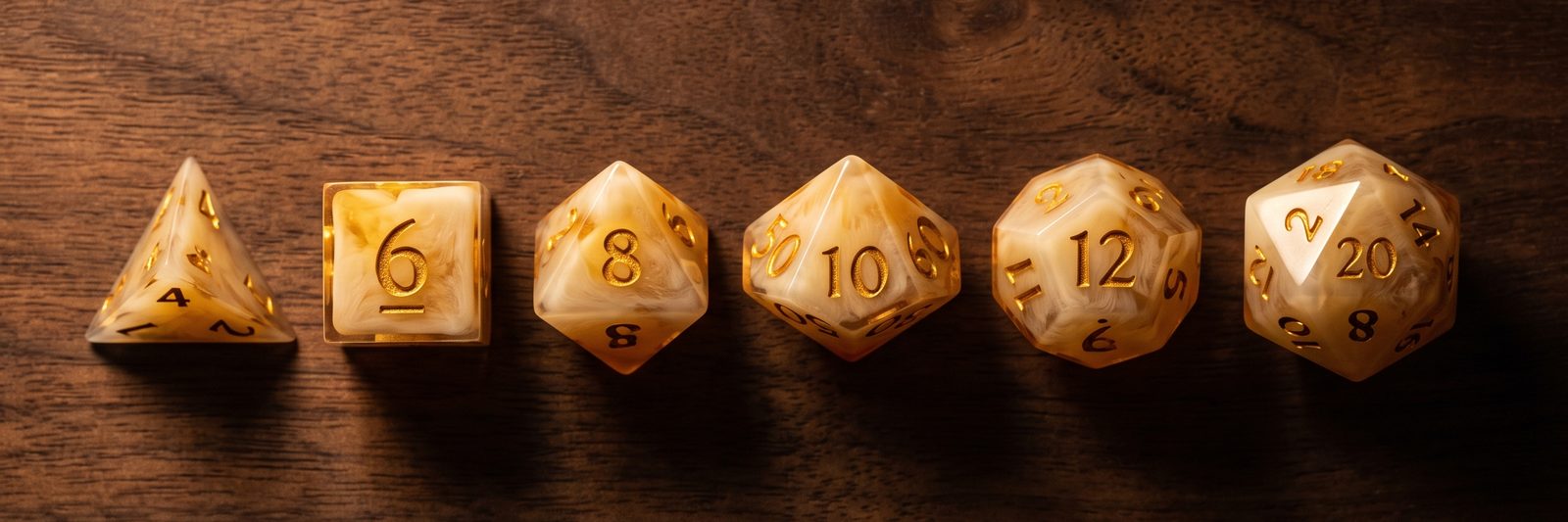
A standard polyhedral set has seven dice: d4, d6, d8, d10, d12, d20 and a percentile d10. The d20 does most of the work in tabletop roleplaying, and the d6 does most of the work everywhere else.
Five of those seven are the Platonic solids, the only shapes where every face is identical and every corner meets the same way. That is not decoration. It is the reason they are fair.
The standard set
| Die | What it is, and what it does |
|---|---|
| d4 | A tetrahedron. Four triangular faces, no top to read, and the reason for a hundred jokes about stepping on one. Small damage rolls. |
| d6 | A cube. The die everyone already owns, in every board game in the cupboard. Pips rather than numerals, usually. |
| d8 | An octahedron. Two square pyramids stuck base to base. A workhorse damage die. |
| d10 | A pentagonal trapezohedron, and the odd one out: not a Platonic solid, because there is no ten-faced one. Half of every percentile roll. |
| d12 | A dodecahedron. Twelve pentagons. The most underused die in most sets, and the nicest to roll. |
| d20 | An icosahedron. Twenty triangles, and the single most recognisable die in gaming. Attacks, checks and saves. |
| d100 | Usually a second d10 marked in tens, read together with the first. Sometimes a genuine hundred-sided ball. |
Why only five shapes are truly fair
For a die to be fair, every face has to be interchangeable with every other. Geometry allows exactly five such solids, which is why the standard set leans on them so heavily. The d10 is the notable exception: it is built from two sets of kite-shaped faces, and it is fair because the faces come in matching pairs rather than because they are all identical.
This is also why the more exotic dice work differently. A d30 or a d24 is a barrel or a trapezohedron rather than a Platonic solid, and a d120 exists but is closer to a curiosity than a tool.
Which extra dice are actually worth owning
A second d20, if you play anything that uses advantage, because rolling two at once is far nicer than rolling one twice. A handful of extra d6s, because dice pool systems and fireballs both want them by the fistful. Beyond that, most exotic dice sit in a drawer.
Reading the awkward ones
Two dice in the standard set are genuinely confusing the first time. The d4 has no upward face, and percentile dice need two dice read together. Both have their own guides: how to read a d4 and how to read percentile dice.
If you want to see the whole collection, including the unusual sizes, the dice directory has every die we roll, from d2 up to d120.