Dice Notation Explained
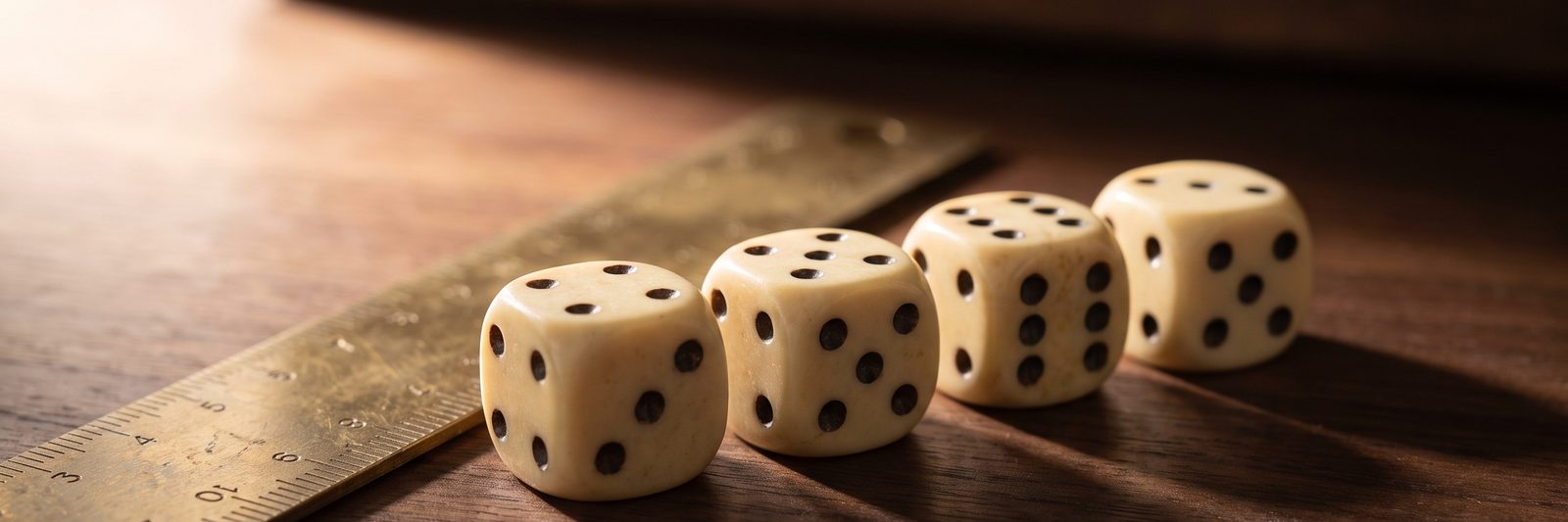
Dice notation is written as a number, the letter d, and another number. The first is how many dice, the second is how many sides each has. So 2d6 means roll two six-sided dice.
Once you can read that much, most of what you will see in a rulebook or a forum post makes sense. The rest is a handful of suffixes that tell you what to do with the dice after they land.
The basic form
3d8 is three eight-sided dice. Roll all three, add them together, and that is your result. If the first number is missing, it means one: d20 and 1d20 are the same thing.
Modifiers
A number after a plus or minus is added once to the total, not once per die. This trips people up constantly. 3d6+2 rolls three dice and adds 2 to the sum, so it lands between 5 and 20. It does not add 2 to each die.
Keeping and dropping dice
This is where notation earns its keep. Sometimes you roll more dice than you intend to use, and a suffix says which ones survive.
| Notation | Meaning |
|---|---|
4d6kh3 | Roll four dice, keep the highest three |
4d6kl3 | Roll four dice, keep the lowest three |
4d6dl1 | Roll four dice, drop the lowest one |
4d6dh1 | Roll four dice, drop the highest one |
2d20kh1 | Roll two d20s, keep the higher. This is advantage |
2d20kl1 | Roll two d20s, keep the lower. This is disadvantage |
Note that 4d6kh3 and 4d6dl1 describe exactly the same roll from two directions. Keep the best three, or throw away the worst one. Both leave you with the same three dice.
In the roll above, the die that did not make the cut is still shown, just dimmed. That is deliberate. Seeing what you dropped is half the appeal of rolling this way.
Exploding dice
An exclamation mark means the die rolls again every time it lands on its highest face, and the new roll is added on. 1d6! that comes up 6 gets rolled again, and if that one is also a 6, again. A chain of three sixes is worth 18 plus whatever the fourth roll gives you.
Percentile shorthand
d% means a percentile roll, which is the same as d100. You will see both. If you want to know how two ten-sided dice produce a number from 1 to 100, that is covered in reading percentile dice.
Putting expressions together
Terms can be added and subtracted freely. 3d8+2d6+7 rolls three d8s and two d6s, sums them all, and adds 7. The dice calculator shows each term worked out separately, which is useful when you want to check a total rather than trust it.
Everything described here works in the Dice Forge, where you can also build a roll with controls and watch the notation write itself.