How to Read a D4
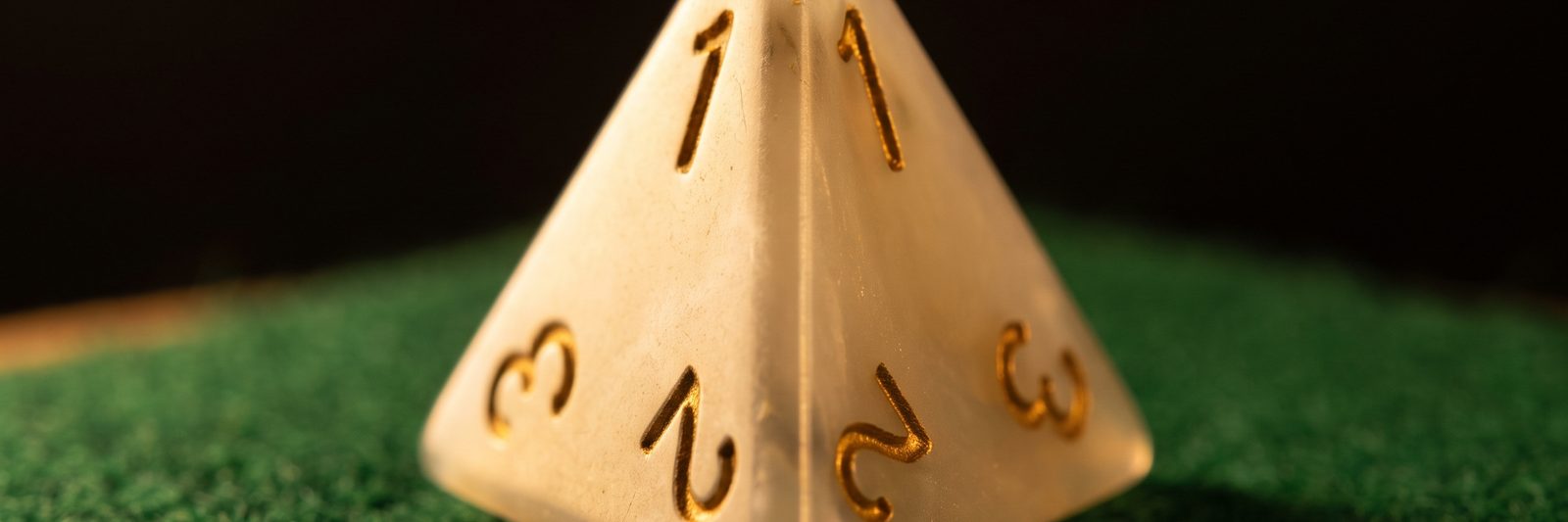
A d4 has no upward face to read. On the common kind you read the number at the bottom edge, repeated along all three visible sides. On the rounded kind you read the number that points up.
Every other die in the set lands with one face on top, and you read that. A four-sided die lands on a face and points a corner at the ceiling, so there is nothing on top to read. This confuses everyone once.
The flat-topped kind
This is the standard tetrahedron, and the one most sets include. Each of the three faces you can see has three numbers on it, one along each edge. The number you want appears three times, once along the bottom edge of each visible face.
So: look at the bottom of the die, where it meets the table. Whichever number is repeated all the way round is your roll. If you see 3 at the bottom of every face, you rolled a 3.
The rounded kind
Some sets use a d4 with a blunted top, sometimes sold as a crystal or barrel d4. These have a single number at the apex, and you read that one. Much easier, though they roll less cleanly because the shape does not tumble the same way.
Why the numbering looks strange
Each face carries three different numbers, which seems like a mistake until you notice that every edge of the die needs to show the same value from both faces that meet there. The numbering is arranged so that whichever way the die lands, the correct result reads the same from all three sides. It is a neat piece of design that looks like chaos.
Try one
Rolled here, the d4 simply shows its number, because a screen has no such problem. If you want the physical version, the d4 page covers what it is normally used for, and the types of dice puts it in context with the rest of the set.
And yes, about stepping on one
A d4 at rest always has a vertex pointing straight up. That is the entire joke, and it is entirely accurate.