How Dice Are Made, and Why It Matters
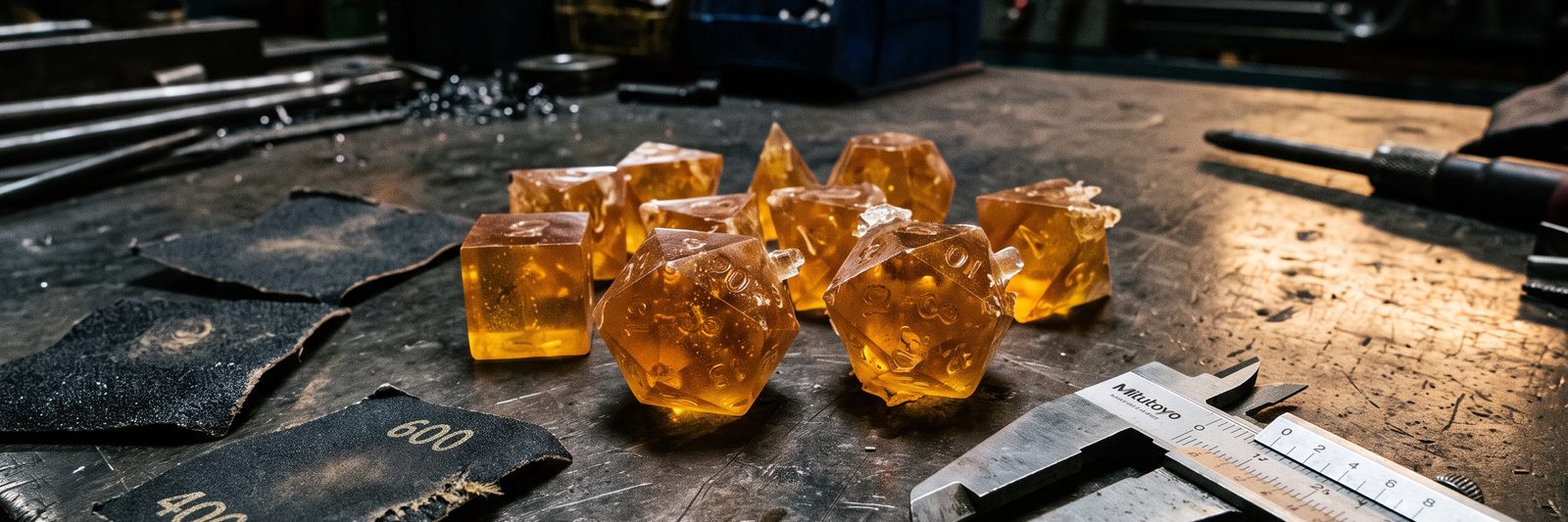
Most dice are injection moulded from resin, then tumbled and painted. The pips, the sprue mark and uneven sanding all shift the weight slightly, which is why no physical die is perfectly fair.
This is not a scandal. The unfairness in a decent die is far too small to notice across a normal game. But it is real, it is measurable, and it is the reason casinos do not use the dice you buy in a game shop.
How a normal die is made
Liquid resin is injected into a two-part mould and left to cure. When the halves separate they leave a seam and a small stub where the resin entered, called the sprue. That stub is clipped and sanded flat, then the whole die is tumbled with polishing media to smooth the edges. Finally the recessed numbers are painted, usually by flooding the surface with ink and wiping the excess off the faces.
Where the bias creeps in
Four places, roughly in order of how much they matter.
The sprue mark is sanded by hand or by machine, and whichever face carried it ends up very slightly smaller. Air bubbles trapped during curing sit wherever they happen to sit, and a bubble near one face lightens that side. On a pipped d6, the six pips on one face remove more material than the single pip opposite, which is why a cheap pipped die is very slightly biased towards the 6. And painted inlay adds a small amount of mass back, unevenly.
Casino dice are different
Precision dice are cut rather than tumbled, with sharp edges and faces flat to within a few thousandths of an inch. The pips are drilled and then filled with paint of the same density as the body, so removing material and replacing it nets out. They are transparent so that internal weights would be visible, and they are retired after a few hours of play because the edges wear.
All of which is a lot of effort to remove a bias that would take tens of thousands of rolls to detect. It matters when there is money on the table.
What this means for a digital roller
None of the above applies here. There is no geometry, no resin and no worn edge, so there is nothing to be biased by. The result comes from your browser’s cryptographic random number generator, and the dice you see are an animation of a number that was already decided.
That has its own honesty problem, which is that you cannot inspect it the way you can hold a die up to the light. How our rolls are generated sets out exactly what happens, and what randomness actually means covers why a computer can be more even-handed than a physical object.
Testing a die you own
The classic method is a salt water float test. Dissolve enough salt in warm water for the die to float, then spin it. If the same face keeps rising, the die is heavier on the opposite side. It catches gross problems, not subtle ones, and a die that passes is not proven fair. But it will find a badly moulded d20.