A Short History of Dice
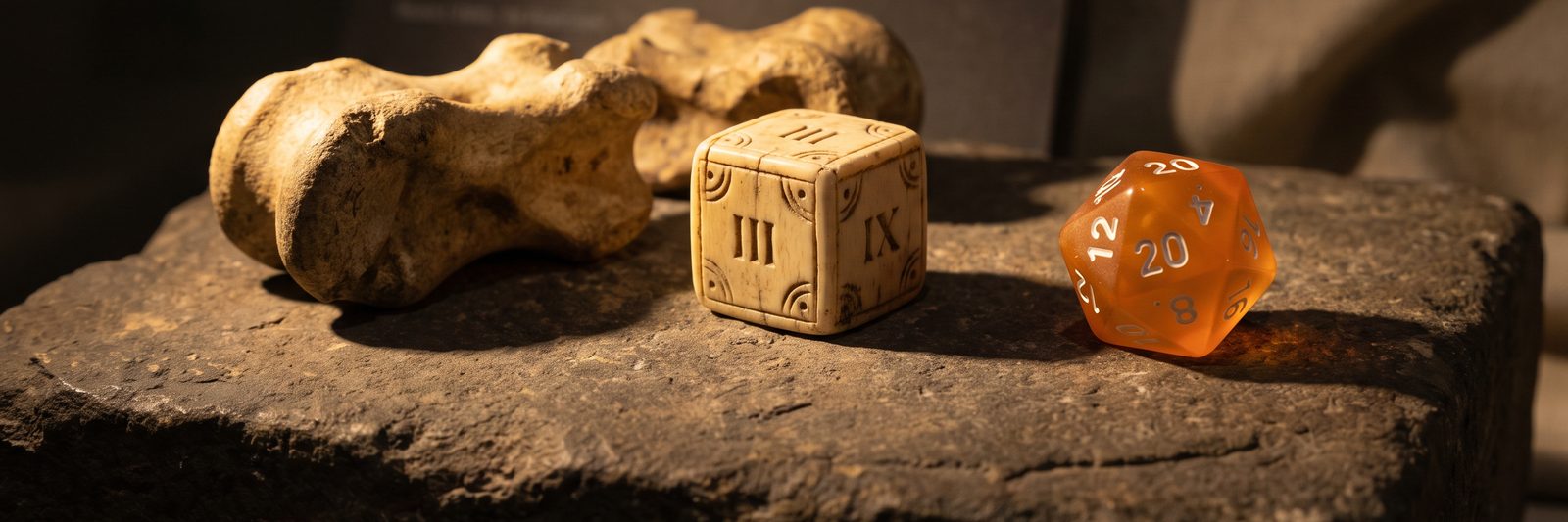
Dice are around five thousand years old. The oldest known dice come from Iran and Iraq, and the earliest were knucklebones from sheep and goats, thrown four ways.
Dice are older than most of the games played with them, older than paper, and considerably older than the idea that randomness is mathematics rather than the will of a god.
Knucklebones came first
The ankle bone of a sheep or goat has four sides it can land on, two broad and two narrow. Thrown in handfuls, they gave the earliest random results people gambled on, and they were used across the ancient Mediterranean and Near East. The Greeks called them astragaloi. Because the four sides are not equally likely, the rarest combinations were the most prized, which is a scoring system rather than a fair die.
Cubes, and the numbering that stuck
Six-sided cubes appear in the third millennium BCE, including in the Burnt City in south-eastern Iran and in the royal graves at Ur. Numbering varied at first. The convention that opposite faces add to seven took time to settle, and once it did it never really moved: a modern d6 still has 1 opposite 6, 2 opposite 5, and 3 opposite 4.
Rome, and the first gambling laws
Romans played dice enthusiastically and legislated against it repeatedly, which tells you how well the legislation worked. Gambling was formally restricted to the festival of Saturnalia, and largely ignored the rest of the year. Loaded dice survive from the period, so cheating is at least as old as regulation.
From chance to probability
For most of that history nobody calculated odds. Results were read as fate or divine intent, and the question of how likely a result was did not obviously have an answer. That changed in the sixteenth and seventeenth centuries, when Cardano, and later Pascal and Fermat in correspondence about a gambling problem, worked out that chance obeys rules.
Probability theory begins there, with dice. Every figure on our probability pages is downstream of that correspondence.
The twenty-sided die
Icosahedral dice are not modern. Egyptian and Roman examples survive, some marked with letters rather than numbers, and their purpose is not always clear. What is modern is the d20 as the centre of a game system, which arrives with tabletop roleplaying in the 1970s and turns a curiosity into the most recognisable die in the world.
The full set followed, largely because a game that already asked you to own one strange polyhedron could reasonably ask you to own six more. The types of dice covers what each one ended up being for.